Tuesday, October 21, 2014

Ten points from ETC


Above is the diagram illustrating how ETC(electron transport chain) works.
And below is my ten points concluded from the lecture(role playing).

1. PSⅡ and PSⅠ both need to absorb light in order to excite the electron, which is gained from water, and transport it.
2. The pathway of electron throughout the process is water -----> PSⅡ-----> PQ-----> b6f-----> PSⅠ-----> Fd------> FNR------> NADP
3. Two hydrogen ions was released when the water break down outside the  PSⅡ. Hydrogen ions also enter PQ to form PQH2. To form the neutral NADPH, hydrogen ion enters to play the role to balance the electron. Large amount of hydrogen ions go through the ATP synthase to slow down its spinning motion in order to form ATP.
4. The process of breaking down molecules by light is called photolysis.
5. Gaining electron of a molecule is called oxidation; losing electron of a molecule is called reduction.
6. Chemiosmosis is the movement of chemicals from high concentration to low concentration through a  selectively permeable membrane. The process of releasing ATP is chemiosmosis.
7. The one help to make ATP is called ATP synthase.
8. It is important that the oxygen leave the water molecule at the beginning, because it will come back again.
9. ETC happens in thylakoid lumen.
10. When the spinning motion of ATP synthase slows down by hygogen, a phosphate come to take away the ADP which has two phosphate atoms in it and from ATP which has three phosphate atoms in it.

Monday, October 20, 2014

Pig Dissection

We did a dissection on fetal pigs on Wednesday and Thursday. Here is a record of what we did and what we found out in the lab.

Wednesday was our first day to dissect the pig. Honestly speaking, it was my first time to dissect an animal, and it was even more interesting than I imagined. As an non-experienced dissector, I felt lucky and glad to learn the anatomy and gain both the knowledge and practical experience at the same time.

Our group got the smallest pig, but it wasn't lack of anything. Here is the overview of our result in the first day.


After we got our pig, the first thing to do was to examine its gender. Because there was a urogenital opening at the lower body, we believed it was a female, which was proved by the two ovaries we found.
ovary

After cutting the lower body open, we first isolated the liver in the middle.
liver

Then we got the small and large intestine, spleen and stomach.
small and large intestine

stomach

spleen

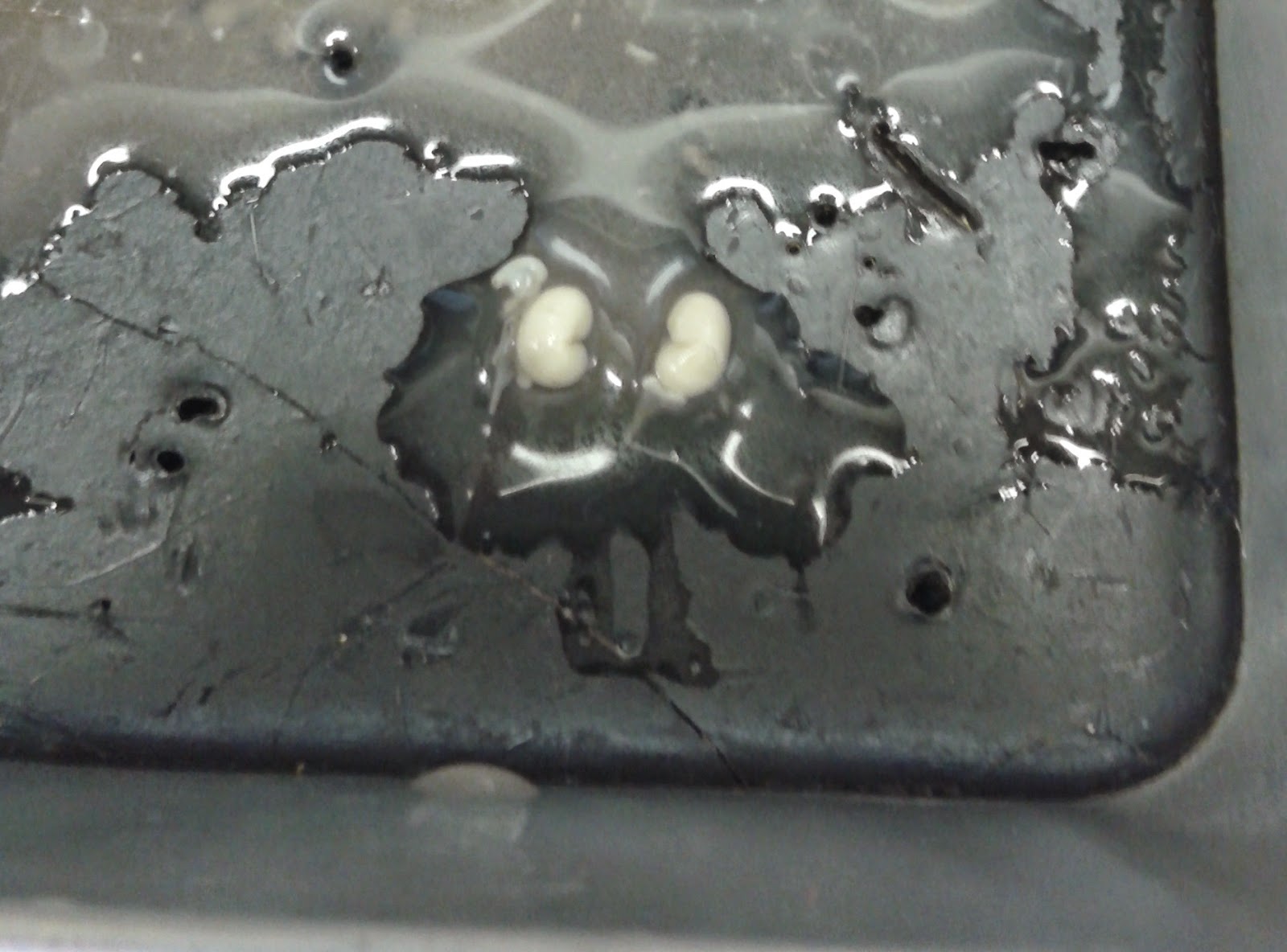
We isolated the two kidneys from deeper at the two sides of top of the intestine. They were cut both cut into half accidentally, and we saw the difference between medulla and cortex.
kidney

On the second day, Thursday, we began to dissect the upper body , including the brain, of the same pig.
When we open the upper body, we saw the heart was surrounded by the two lungs at back.
heart

lungs(shaped like to embrace the heart)
Then we got to work on the brain. To get the brain out, we needed first to open the very hard skull which had the job to protect the brain inside. We tried to cut from the top middle side of the skull carefully, but it was difficult to control the intensity to ensure the skull can be widely opened and the brain was not injured at the same time.

At last, we just got the mushy brain like this(probably because our pig is immature).
brain
There is the brain from the group which successfully got the one.
what the brain should look like
Finally, we also get one eyeball out. It was a tiny round ball in front of the brain.

This experience of dissection is fun, unique and also informative for me. By dissecting the body of fetal pig, I practically see what the organs look like and where they are. I think this is more meaningful because the organs in pig are quite similar to human.

Tuesday, September 16, 2014

The Story of Stuff: A Critical Analysis

2.What audience do you believe Annie Leonard is trying to reach?
I think Annie is trying to reach common people or consumers, especially in developed countries like the US.

4.Why do you think Annie Uses the format of a 20-minute video rather than another format, such as report, web blog, or poster?
I think the reason why she uses the 20-minute video is this format is interesting, approachable, and informative at the same time. Nowadays, many people may not have the interest and time to read a word report or a long poster so a video attracts more people. And the images in the video vividly give people the idea of what Annie is trying to illustrate.

6.Who might disagree with Annie's message? Why do you think they would disagree?
I think the economists and some people from the government might disagree with Annie's message because the rapid consumption does contribute to the growth of global economy and therefore help to  stabilize the world's political situation. People can't live on the level of living quality right now they have without a developed economy and safe political environment. And some scientists may doubt the possibility of the cycle of the whole system she proposed in the end of the video for various scientific reasons, such as some chemical changes are irreversible.

8.Has The Story of Stuff affected the way you think about consumption? If so, how?
The story of stuff makes realize I need to choose to consume the goods that could last longer. Before I may think people are free to buy any fashionable products they want and throw away the rest. After watching the video, I agree that buying "design- to- dump" products is helping some business man earning money on the cost of our planet.

Monday, September 8, 2014

Video Worksheet: The Cove

2.Where is the dolphin slaughter taking place(city and country)
In the documentary, the slaughter is taken place in Taiji, Japan.

4.What is the turning point in his life that makes him completely change and "turn his Porsches in for this crusade"?
When he was working for the  popular American TV show Flippers, the dolphin Cathy, who played Flipper most of the time, died in his arms, making him realize that this kind of animal should not suffer this stress any more.

6.What country indirectly runs the International Whaling Commission?
The IWC is indirectly ran by Japan.

8.How do the fishermen trap the dolphins in the cove?
The fishermen gather together to hunt for dolphins in the ocean, then they surround them and push them to the cove, where they can drop the nets and trap the dolphins.

10.How many dolphins are killed at this secret cove a year?
23000 dolphins are killed a year.

12.What toxic substance is found in dolphin meat?
The toxic substance is mercury.

14.Dolphin meat has 2000 ppm of mercury in it while the recommended amount is no more than 0.4 ppm. Why do many Japanese people eat then?
They are unaware of the danger they are taking and they do this under the permission of the government.

16.The number of fish is severely declining. What is the cause?
The large consumption of fish makes people over-hunting fish.

18.What is the form of propaganda they plan to use to "sell" dolphin meat to people?
They provide the compulsory lunch which includes dolphin meat to children,

20.The main character goes to the IWC and does what at the end(even though he is banned from their meetings)?
He showed the video taken secretly about the inhumane scene of fishermen in Taiji slaughtering dolphins in the cove.

22.When was whaling banned?
In 1986.

Sunday, September 7, 2014

Dry Lab: Mark-Recapture Sampling

On Friday we did a dry lab, and here is what we have done and some analysis.

The purpose of this lab is using mark-recapture method to estimate the population of the pasta in a bag just to model how wildlife researchers did when they estimated the size of population in surveyed area.

Here is the materials we used. A package of macaroni and some colorful markers.


The first step of this lab was to "capture " a sample of population from the bag.

For calculation, we also recorded the number of this sample of population(M), which is 31.

Then we used the marker to mark the captured population.
For the first trial, we chose purple.

Making sure our way of marking is recognizable.(We colored the whole thing.)

After that, we released the captured population(M) back to the bag, and kept shaking it until they were randomly mixed with the general population.

Then, we took a second random sample of pasta(n) and recorded how many of them were marked(m). The data n and m were also written down for calculation which was 4 and 76.

Finally, we were able to calculate the estimated population size of the general population(N) using out recorded data M, m and n.

Here is the details of our calculation.
We used the formula of mark-recapture method.

number of individuals caught & marked in first sample(M) 
                           total population size(N)

 =   number of marked individuals recaptured(m)
total number in second sample(n)

To get the value of N, the formula can be transformed as 
N=(Mn)/m

Due to our data recorded, the calculation would be 
N=(31*76)/4
N=589

After this, we did another 2 trials in the same way, and got the N value of 1334 and 413.

Analysis

1.Compare your estimate of the size of the pasta population with the true size. How close were you?
We counted the real number of the general population as the theoretical value.The formula is shown:
theoretical value - experimental value  *100%  
               theoretical value

={721-[(589+1334+413)/3]}/721

=8%

100%-8%=92%

Therefore we have 92% of accuracy.

2.a) What problems do you think might affect the accuracy of your estimate?
The problems may include the unevenness of mixing pastas, so there would be a large chance that having more or less marked pasta in the second sample population than it should have due to the ratio.So 3 trials may not provide the number fairly enough.  Another problem is our group might have dropped some of pasta when grabbing the sample population so it can affect the accuracy of data collected, but this one is the problem that can be avoided.

b)This activity was not completely valid in that the population was non-mobile.What problems might ecologists studying animal populations encounter?
When it comes to the real animal world, the way of marking can be a problem because the animals are able to move under their own wills and try to wash the color or take away other marks. The variables in natural environment are relatively harder to control. For example, there can be natural disasters and diseases. Besides, there will be a problem of mixing if the type of animal is non-mobile because the sample population will basically remain as a population and tend not to mix with the general population.

3.How might you improve your sampling design?
To improve the sampling design, I will add more trials to provide more data in order to minimize the problem of unevenness. The size of the second captured population should be larger to offset the contingency of re-capture.( And the markers should be more suitable for coloring on pasta and more washable on hands.)